
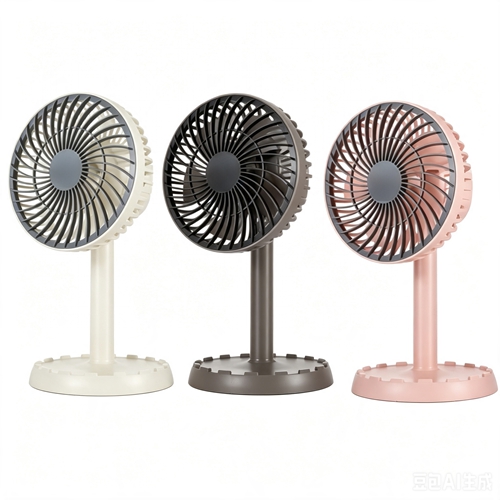
Match a table fan control layout by identifying the model and sample version, requesting clear views of the relevant surfaces, and asking the supplier to label the actual controls. Keep position and appearance separate from the documented function. Approve the location map and supplier legend together so the purchase does not rely on guessed button functions or a photograph of a different variant.
Use the catalogue picture to identify the inquiry
JY SUPER lists JY-2218 as a table fan reference and presents several colours in its catalogue image. The photograph can help the supplier identify the item a buyer means. Its scale and angle do not establish the function of each visible feature around the base or the exact control arrangement of every offered version. Ask for confirmation tied to the quoted model.
State whether the inquiry concerns one particular colour and version or a comparison of proposed alternatives. A buyer should not assume that a different colour is either functionally identical or functionally different. Request the supplier’s explanation. The model reference, colour description and sample version should remain distinguishable fields in the approval record.
Request views that make the layout readable
Ask for a clear photograph of the surface where the supplier identifies the controls, together with a complete view showing where that surface belongs. If relevant markings are on another side, request a corresponding view. The supplier should state whether all the photographs show the same sample. Keep unexplained differences pending instead of combining the most convenient details from several images.
A circular shape, opening or raised area is not automatically a control. Ask the supplier to distinguish controls from other visible features before adding them to the schedule. Where a marking cannot be read, request its wording or symbol description in writing. Do not assign a familiar function because another fan uses a similar-looking feature.
Build a location map and a separate function legend
Use neutral position labels on the sample photograph, then ask the supplier to fill in the appropriate descriptions. The buyer’s labels locate the questions; the supplier’s legend explains the offered configuration. This arrangement makes it possible to approve visual positions without pretending that those positions prove how the product operates.
Approval field | What to record | What remains supplier-confirmed
Sample reference | Model and version identifier | Which quoted item the views represent
Control position | Neutral label on the relevant photograph | Whether the feature is an actual control
Visible marking | Readable wording or symbol reference | Its intended meaning for the offered version
Function description | Supplier’s documented legend | Applicable product specification or instructions
Variant relationship | Colour and version references | Whether the layouts differ
Separate appearance approval from operating claims
A control-location record can establish the arrangement the buyer wants the supplier to confirm. It cannot verify performance, battery capacity, operating time, electrical ratings or compliance. Keep any required product specifications and supporting documentation separate. A labelled picture should not be presented as evidence that a setting achieves a particular result.
The layout schedule is also not an operating or service instruction. Request the supplier’s appropriate documentation for the quoted item when needed. Do not create instructions by guessing what each control does. The commercial approval should identify the version and the visible details that were accepted, while leaving the supplier’s operating information clearly attributed.
Record proposed changes before accepting a revised sample
Ask the supplier to identify any proposed change to control positions, markings or the related layout. A revision may look small in a product photograph but still require a different explanation in the order file. Keep the earlier reference available so the team can see which part of the sample record is being replaced.
If a colour proposal comes with a different-looking base or control surface, ask whether that difference is intentional. Do not approve it merely because the overall fan outline is similar. Request a model-linked response and an updated legend where applicable. The buyer can then accept a named revision or keep the proposal open without silently changing the specification.
Keep the approved layout connected to product communication
The approved sample record should identify the model, selected version, complete view, control-detail view and supplier legend together. When packaging or product information is prepared, ask the supplier to check that the referenced layout matches the offered item. Reusing a generic control picture can create confusion if the actual approved arrangement differs.
On a repeat inquiry, provide the same approved reference and ask whether the new quotation uses it. A reused marketing photograph does not independently confirm the latest control layout. Preserve any supplier explanation of a change and update the record deliberately. This keeps appearance, model identity and documented function connected without making unsupported performance promises.
• Identify the model and sample version before labelling controls.
• Ask which visible features are controls rather than guessing.
• Keep the location map separate from the supplier’s function legend.
• Review a changed marking or layout as an explicit sample revision.
Frequently asked questions
Can control functions be inferred from the catalogue photograph?
No. Use the image to identify the item and locate questions. Ask the supplier to name the actual controls and provide the applicable model-specific description or documentation.
Does another colour necessarily use the same control arrangement?
Do not assume either relationship. Ask the supplier to explain whether the quoted colour and version use the same layout. Record a confirmed difference as a version detail.
Does a control legend prove battery life or airflow performance?
No. A legend describes the documented function of the offered controls. Performance, electrical specifications and any required assessments need their own item-specific supplier evidence.
What should be kept for a repeat-order check?
Retain the exact model, sample version, complete view, labelled detail view and supplier legend. Ask the supplier to confirm whether the new quotation matches that reference and identify any proposed alteration.
Product and contact references
Catalogue reference: confirm matching item: https://jysuperofficial.com/product/jy-2218/
Related catalogue reference: https://jysuperofficial.com/product/jy-2215/
Contact JY SUPER: https://jysuperofficial.com/contact/
JY SUPER blog: https://jysuperofficial.com/blog/